

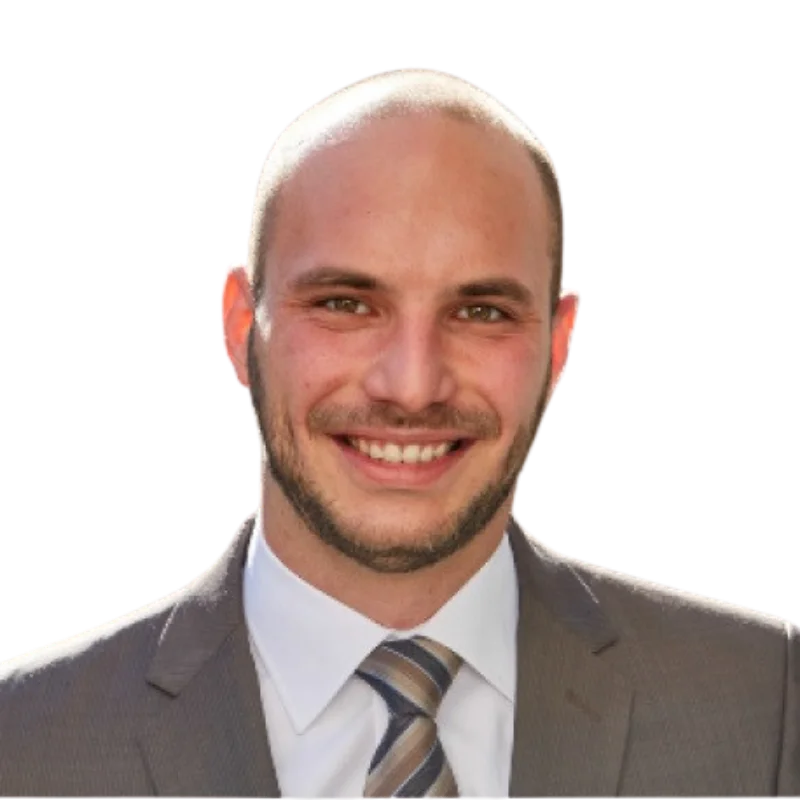
From economic consulting to protecting humanity's long-term future
Georg Arndt took an unconventional path into consulting—he wanted to prove himself wrong. After five years at NERA Economic Consulting in Berlin, he found his way to work he'd been searching for since his school years: contributing to something meaningful. Today, as Chief of Staff at GovAI, he helps shape programs that could influence humanity's long-term future.
The transition wasn't always smooth, but Georg spoke with us candidly about testing his assumptions, finding meaningful work, and why the challenges were worth it.
You had an interesting reason for entering consulting—you wanted to test whether consultants were actually uptight and unfriendly. Can you tell us about that?
I did economics as an undergrad and decision science as a master's. At the end of my master's, I wasn't sure what to do. I applied for some behavioral economics PhD programs, but I also thought I should try consulting, because I always thought consultants are way too uptight and kind of unfriendly people. I wanted to have an inside view of whether this was correct—almost like a scientist trying to falsify my own hypothesis.
I looked at a list of consultancies, and NERA was the only economic consultancy in Berlin, so I applied. I started with an internship for six months, realized I actually did like the work, and then just stayed after my internship.
What did you find? Were consultants as uptight as you thought?
The people were much closer to academic economists than I expected. It was much more brain-heavy and academic. I got along pretty well with the wonky nature of the people and the work. I worked mostly on arbitrations in the energy sector, and I really enjoyed the intellectual challenge of winning arbitrations. Research is fun. All of it was making sense to me.
You did well there—got promotions, had good colleagues. What made you start questioning that path?
After about two years, I realized something was missing. The work was engaging and intellectually challenging. My colleagues were nice people. I earned enough to live well in Berlin. But the work didn't match particularly well with my values and wasn't particularly fulfilling from that perspective.
So I started looking around for how I could either complement or substitute the work I was doing. I took breaks of about two months per year. I got involved in the unconditional basic income movement in Germany. I looked into doing a part-time PhD. But none of that really provided the meaning I was looking for. I spent a few years searching without finding the right fit.
How did you find your current path?
After about four years, someone suggested I read Doing Good Better, a book about thinking carefully about how to have an impact with your career. I realized that approach sounded way more like what I actually wanted to do with my life.
It resonated because the framework was relatively close to economic thinking—consequentialism, working with existing incentives, thinking carefully about impact. Through my reading, I discovered organizations like 80,000 Hours and came across the idea of working on humanity's long-term future. Since my school years, I always wanted to contribute to something large, and it doesn't get much larger than that.
That transition happened remarkably fast—you went from discovery to a new job in six months.
I discovered this approach around late December. I applied for a project manager position at the Future of Humanity Institute in March and started my new job in June. Once I found what I was looking for, things moved quickly.
What was the transition like? What surprised you?
The biggest surprise was the organizational shift. I went from a relatively well-structured environment in consulting—with a hierarchy, teams, and clear tasks—to "here's a very vague description of what needs to happen, please figure out what it actually is and then do it." Plus, very light-touch management and leadership. There was probably an order of magnitude more ambiguity in my job than on the consulting side.
The topics were also intense—my first real encounter with existential risk was challenging. About three months in, I went through a difficult period for a few months. I wish I'd sought support earlier, like finding a therapist sooner. I also should have connected with more people in the community earlier. Something like Consultants for Impact would have helped me quite a lot.
But I got through it, and looking back, I could have prepared better by knowing what to expect and building support networks from the start. This ecosystem has a really distinct culture and communication style. High feedback culture, very open and direct communication. We use Bayesian reasoning, think in probabilistic terms, and express views as percentages.
I haven't found another place outside this community that approaches work and communication in quite this way. I really enjoy being in this environment, but it's still something that takes time getting used to.
Can you tell us more about what drew you to this work?
The core idea is that the future matters as much as the present. You think about impact broadly—not just your neighborhood, but people on the other side of the planet, and importantly, people in the future. Finding out what actually works, working pragmatically with existing systems, and thinking carefully about how to have the most impact. That framework just clicked for me.
You're now Chief of Staff at GovAI. What does that role look like?
Once I started at FHI, I quickly got absorbed by AI and realized it could be transformative—for good or bad. GovAI works to improve decisions about AI by providing better information to key decision makers in governments and labs who will have outsized influence over how AI develops.
My role has three main areas. First, all the non-researchers at GovAI report to me. Second, I support our director with day-to-day decisions. Third, I maintain a high-level overview of everything happening at GovAI and make sure we are adequately staffed and resourced. Over the last two years, much of my time has gone into hiring as we've grown.
What advice would you give consultants considering this kind of transition?
First, two to three years of consulting is probably enough to build the skills you need. Finding resources like Doing Good Better and 80,000 Hours earlier would have led me to make the shift sooner.
Second, seek out community and take care of yourself. Connect with organizations like Consultants for Impact. The transition involves real challenges—the working environment is very different, the topics can be intense, and there's much more ambiguity. But knowing that going in helps a lot.
Third, prepare for the culture shift. This ecosystem thinks and communicates differently. It's startup-like in some ways, but with its own distinct approach. Give yourself time to adjust.
Looking back, was the transition worth it?
Absolutely. I spent years searching for work that aligned with my values, and I found it. I always wanted to contribute to something large, and now I'm working on decisions that could shape humanity's long-term future. The intellectual challenge is there, I'm working with brilliant and motivated people, and the work genuinely matters to me.


